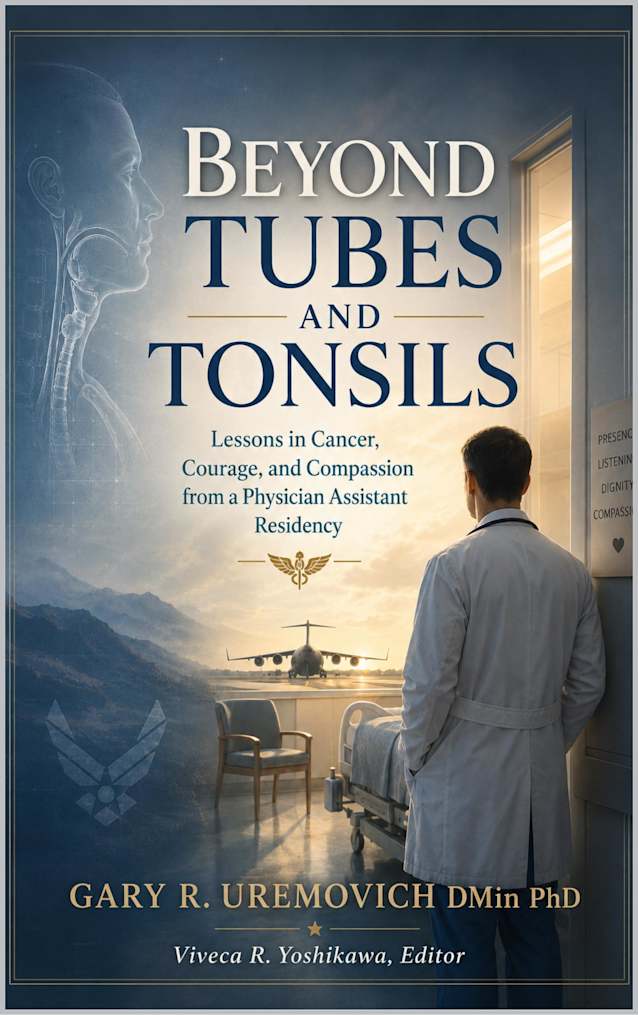
Beyond Tubes and Tonsils: Lessons in Cancer, Courage, and Compassion from a Physician Assistant Residency
About
Beyond Tubes and Tonsils: Lessons in Cancer, Courage, and Compassion from a Physician Assistant Residency
Beyond Tubes and Tonsils is not simply a memoir of medical training. It is the story of how a young Physician Assistant entered an ENT–Head and Neck Surgery residency expecting a specialty of ear infections, sinus problems, tonsils, and tympanostomy tubes—and instead found himself confronting cancer, disfiguring surgery, suffering, faith, fear, death, and extraordinary courage.
Gary R. Uremovich, DMin, PhD, had already practiced as a certified Physician Assistant for six years and was serving in the United States Air Force when he chose advanced specialty training in otolaryngology. Part of the decision was practical: as a husband and father of three, he hoped specialization might lessen the chance of a remote military assignment away from his family. What he did not expect was that head and neck cancer would become one of the most demanding and transformative parts of his professional life.
In these deeply personal clinical vignettes, Uremovich looks back on the patients who became his greatest teachers. He describes men and women facing cancers that threatened the very functions through which people experience and express life—speaking, swallowing, breathing, hearing, smelling, tasting, and even being recognized by those they love. The stories move beyond diagnosis and treatment to the human realities behind the chart: a patient who has lost his voice, a frightened spouse struggling to enter a hospital room, children confronting a parent’s altered appearance after radical surgery, and clinicians discovering the limits of what medicine can cure.
These are not heroic tales of a young PA rescuing patients from disease. They are stories of learning, uncertainty, humility, and presence. Uremovich writes candidly about the discomfort of not having an answer, the spiritual questions raised by suffering, and the difficult realization that there are moments when treatment can no longer change the outcome. In those moments, medicine still has work to do. Pain can be relieved. Fear can be acknowledged. Dignity can be protected. A family can be helped through a doorway. A chair can be pulled beside a bed.
The lessons of that residency remained with him throughout a forty-two-year career in clinical medicine and otolaryngology. During the final three years of his twenty-six-year Air Force career, he returned to serve as director of the residency program that had once trained him. Later, as the founding director of a Physician Assistant program in North Carolina, he helped prepare and mentor future generations of clinicians, passing forward lessons first taught to him by patients decades earlier.
Beyond Tubes and Tonsils is both medical memoir and reflection on what it means to care for another human being. It explores the difference between knowing a disease and knowing a patient, between technical competence and compassion, and between curing and caring. It also asks difficult questions about faith, suffering, mortality, professional identity, and the responsibilities clinicians carry when there is no longer anything left to “fix.”
Written for healthcare professionals, students, caregivers, cancer survivors, families, and anyone interested in the human side of medicine, this book offers a perspective shaped by decades of clinical practice, teaching, military service, and reflection. The cases arise from real clinical experiences, with names and identifying details changed to protect patient privacy. Medical knowledge changes. Procedures evolve. Treatments once considered advanced become outdated. Yet the need for compassion, humility, listening, and presence remains.
Gary entered residency looking for tubes and tonsils. What he found was a lifetime of medicine—and patients who taught him the rest.