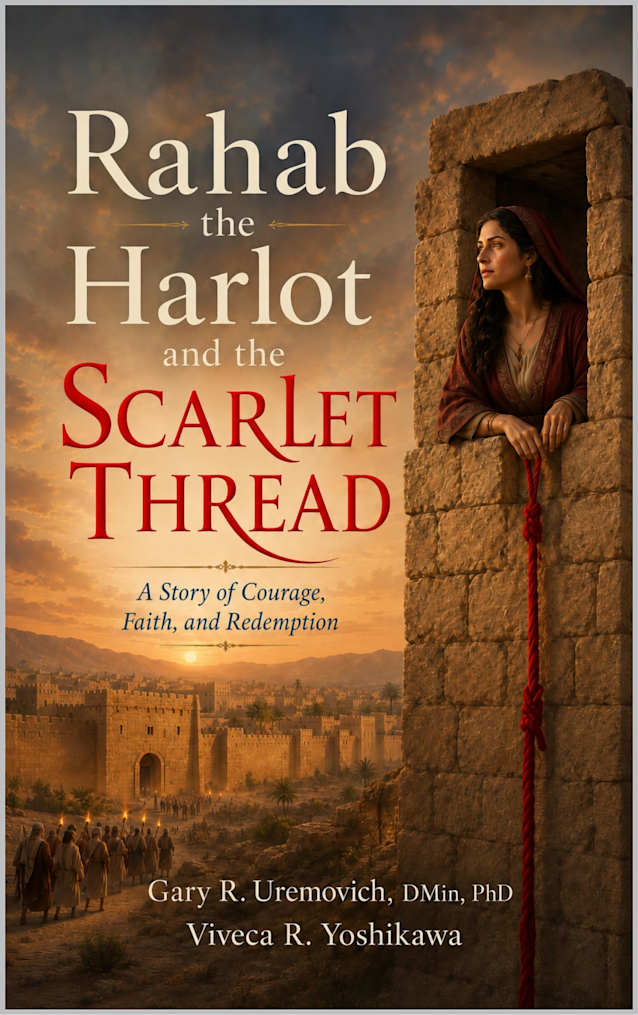
Rahab The Harlot and the Scarlet Thread: A Story of Courage, Faith, and Redemption (Women of the Bible that Changed the World.)
About
Rahab The Harlot and the Scarlet Thread
by Gary R. Uremovich, DMin, PhD, and Viveca R. Yoshikawa
In the ancient city of Jericho, Rahab lives in the wall—close enough to hear the fear behind the city’s boasting, close enough to hear rumors from beyond the Jordan, and close enough to know that stone walls cannot protect a soul from sorrow. Jericho calls itself strong, but Rahab has learned that its strength does not extend to women like her.
Born the daughter of Ammiel and Keziah, Rahab was once a sharp-eyed child of Jericho, loved by her family and full of questions about the world beyond the walls. But poverty, debt, exploitation, and the cruelty of powerful men narrowed her future until survival came at a cost she never wanted to pay. Jericho gave her a name, but it did not tell the whole truth of her story.
Then the rumors begin.
A people called Israel has come out of Egypt. Their God has humbled Pharaoh, opened the sea, fed His people in the wilderness, and defeated kings beyond the Jordan. This God is unlike the silent idols of Jericho. He moves. He acts. He remembers.
And Rahab begins to wonder: If the God of Israel remembered slaves in Egypt, could He also remember a woman in Jericho?
When two Israelite spies come to her door, Rahab must choose between the only city she has ever known and the God she has barely begun to understand. She hides the spies, risks her life, confesses that Yahweh is God in heaven above and on earth beneath, and asks for mercy—not only for herself, but for her father, mother, sisters, and all who belong to her household. The spies give her a promise. A scarlet cord.
Rahab the Harlot and the Scarlet Thread is a sweeping biblical historical novel of loss, courage, faith, and redemption. It imagines the life behind the biblical account of Rahab, exploring the hidden years that shaped her: her family, her wounds, her questions, her survival, and her awakening faith in the God of Israel.
This story does not reduce Rahab to the name Jericho gave her. It follows her as daughter, sister, survivor, protector, believer, wife, mother, and vital woman in the lineage of the Messiah.
When Jericho falls, Rahab’s rescue is only the beginning. Taken out of the city but not yet fully taken in, she must learn what it means to live among the people of promise. She learns Israel’s songs, carries the weight of an old name, receives a new tent, and slowly discovers that Yahweh’s mercy does not merely spare lives—it restores them.
Among the people of Israel, Rahab meets Salmon of Judah, a man of spiritual maturity, compassion, and integrity. He does not look at her through the eyes of Jericho. He sees a woman whom Yahweh has already seen. Their covenant love becomes part of Rahab’s healing, and from their union comes Boaz.
Boaz does not become a man of kindness by accident.
He is formed by his mother’s story.
This is the wonder of Rahab’s story: God’s redemptive plan is not woven only through perfect people, polished reputations, or untouched lives. It moves through wounded histories, foreign women, grieving widows, unexpected faith, and the astonishing mercy of God.
Rahab the Harlot and the Scarlet Thread invites readers to enter the biblical story with fresh imagination and reverence. For readers who love biblical fiction, strong women in Scripture, redemptive family legacies, and the grace of God at work in complicated lives, this novel offers a moving journey from shame to faith, from Jericho’s wall to Bethlehem’s fields, and from a scarlet cord to the lineage of Christ.
Rahab’s past did not have the final word.
Jericho did not have the final word.
Mercy did.