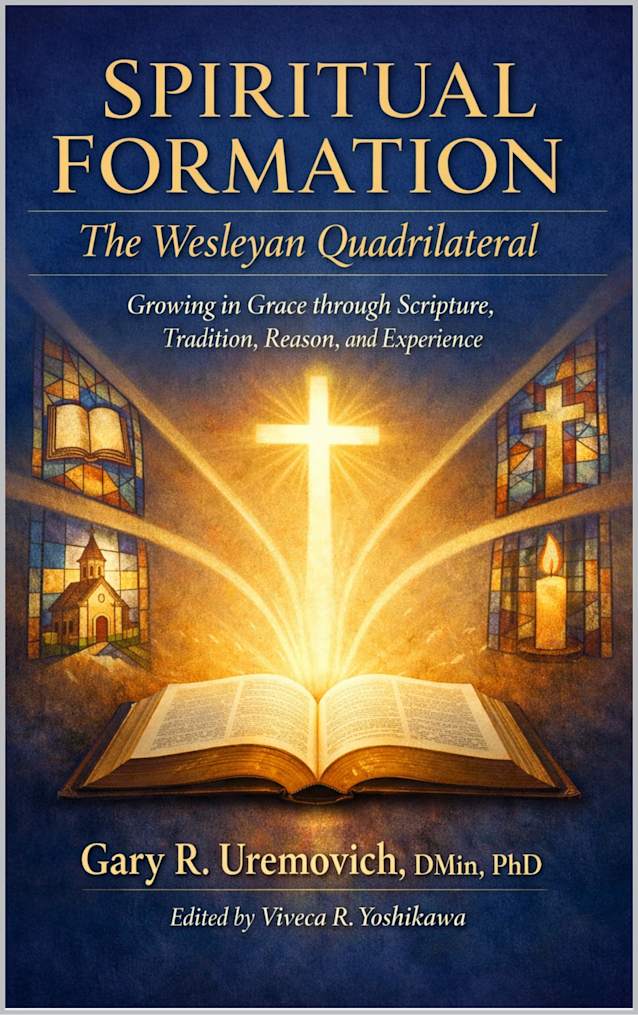
Spiritual Formation: The Wesleyan Quadrilateral: Growing in Grace through Scripture, Tradition, Reason, and Experience (Conversational Small Group Bible Studies)
About
Spiritual Formation: The Wesleyan Quadrilateral is a thoughtful and practical exploration of how Christians are formed into the likeness of Christ through the faithful integration of Scripture, tradition, reason, and experience. At its heart, the book argues that spiritual formation is not merely the accumulation of religious knowledge or the performance of devotional habits. It is the lifelong, gracious work of God in the whole person—mind, heart, character, relationships, habits, and actions—so that believers increasingly reflect the life of Jesus in the world. Using the Wesleyan Quadrilateral as its organizing framework, the book offers readers a balanced and deeply pastoral way of understanding Christian growth, discernment, and discipleship.
The book makes clear from the beginning that the Quadrilateral is often misunderstood. Scripture, tradition, reason, and experience are not presented as four equal authorities competing for influence. Rather, Scripture stands as the church’s foundational and governing authority, while tradition, reason, and experience serve as faithful and necessary aids in interpreting and applying biblical truth. Tradition offers the accumulated wisdom of the church across time. Reason reflects the God-given ability to think, interpret, and discern. Experience points to the lived reality of grace in the life of the believer and in the community of faith. Held together properly under the primacy of Scripture, these four help Christians remain rooted without becoming rigid, thoughtful without becoming cold, spiritually alive without becoming unstable, and open to grace without surrendering truth.
Drawing on the life, ministry, and theological vision of John Wesley, the book shows that this framework is not merely a theory for scholars or clergy. It is a practical guide for ordinary Christians who want to live faithfully in a complicated world. Wesley’s concern was never theology for its own sake. He wanted doctrine to become discipleship, grace to produce holiness, and faith to become visible in love, mercy, worship, and transformed character. That same concern animates this book. The Quadrilateral is presented not as an abstract method, but as a way of seeking truth humbly and living before God with sincerity, wisdom, and spiritual depth.
As the book unfolds, it applies this framework to the real work of Christian life. It explores how the Quad shapes spiritual formation, the means of grace, everyday decision-making, Christian growth, group Bible study, church life, moral discernment, and the ongoing challenge of spiritual maturity. It also addresses critiques and misunderstandings of the Quadrilateral, showing why it still matters in a time marked by confusion, polarization, shallow certainty, and spiritual imbalance. Again and again, the emphasis is practical: believers need more than slogans, impulses, or private opinions. They need a faithful pattern for hearing the Word of God, receiving the wisdom of the church, thinking clearly, and recognizing the genuine work of grace in lived experience.
A central strength of the book is its insistence that spiritual formation is ultimately the work of the Holy Spirit. The Quadrilateral is useful but not self-sufficient. The Holy Spirit is the one who illumines Scripture, brings wisdom to tradition, guides reason into humility, and helps believers interpret experience truthfully. In that sense, the book presents the Quadrilateral not as a mechanical formula, but as a gracious framework through which God forms His people. The goal is never simply to master a method. The goal is to become the kind of disciple who can read Scripture with reverence, learn from the church with humility, think with honesty, test experience wisely, and grow steadily in grace.